


July 14, 2026 (updated: August 3, 2026)
CAMI III Challenge Information
We are excited to announce the start of the third round of challenges of the Initiative for the Critical Assessment of Metagenome Interpretation (CAMI). The first CAMI III challenge dataset, called CAMI III Longitudinal Human Gut, is now available at www.cami-challenge.org/datasets. It is based on a longitudinal study of stool microbiota from nine individuals, comprising four stool metagenome samples per individual. Both short- and long-read shotgun metagenomic data representative of current sequencing technologies are provided.
CAMI III evaluates methods for metagenome assembly, genome binning, taxonomic binning, and taxonomic profiling on complex microbial communities using both short- and long-read sequencing data. The release of the first CAMI III challenge dataset follows the release of the CAMI III Toy Longitudinal Human Gut dataset in March of this year, which was designed to allow participants to become familiar with the data formats and evaluation procedures. Unlike the toy dataset, the Longitudinal Human Gut challenge dataset includes novel microbial genomes, while continuing to cover taxa from multiple domains, such as bacteria, archaea, fungi, viruses, plasmids and host.
Additional challenge datasets will be released throughout the challenge period.
We look forward to your submissions!
The CAMI Team (cami-challenge.org/contact)
Challenges
CAMI III starts with several challenges: an assembly, a genome binning, a taxonomic binning, and a taxonomic profiling challenge on the Longitudinal Human Gut benchmark dataset, including short- and long-read data. Further datasets and challenges will be released over the next months.
- Assembly challenge: Provides read samples of a given dataset and accepts the following: (a) a cross-sample assembly of all samples, (b) patient-specific cross-sample assemblies for all samples from one patient each, or (c) single sample assemblies for all samples. Assembly results can be submitted for short read data OR long read data, OR both data types combined. For methods incapable of submitting a cross-sample assembly for the entire dataset, the FIRST TEN samples of a dataset can be assembled and a ten-sample cross-assembly submitted. Participants can also submit single-sample assemblies for each of the first ten samples of a dataset. The assembly challenge will close early, namely once a gold standard assembly has been released after 3 months! Details of the specifications of the CAMI evaluation for strain-aware assemblers can be found at https://www.microbiome-cosi.org/images/Specification_of_CAMI_evaluation_for_strain-aware_assemblers.pdf
- Profiling challenge: Provides read samples of a given data set and accepts cross-domain taxonomic profiles (viruses, eukaryotes, bacteria, archaea, and plasmids) for all individual samples. In addition to profiles based on the NCBI taxonomy (version of July 1, 2026), we also accept GTDB-based profiles using GTDB R226, with the latter covering only bacteria and archaea. For NCBI taxonomy-based profiles, assessment will be performed both with and without plasmids. Plasmid abundances can optionally be included in a profile using the path 2787854||||||||45202 corresponding to the NCBI taxon IDs 2787854 (“other entries”) and 45202 (“unidentified plasmid”). The profiling challenge closes after six months.
Profiling reference data availability: The challenge datasets are available from the challenge portal after registration. The NCBI taxonomy version and reference genomes can be downloaded from the Reference databases page. For GTDB R226, taxonomically annotated reference genomes and the corresponding taxonomy are available at https://data.gtdb.aau.ecogenomic.org/releases/release226/.
Profiling format: See how to format GTDB-based taxonomic profiles on the File formats page. - Genome binning challenge: provides reads, gold standard assemblies, and assemblies per sample — assemblies are provided by CAMI three months after the release of the reads. It accepts genome bin assignment for the analyzed reads or contigs for every sample of a dataset in the CAMI format. This challenge closes six months after the start.
- Taxon binning challenge: Provides reads, gold standard assemblies, and assemblies per sample — assemblies are provided by CAMI three months after the release of the reads. It accepts a taxon bin assignment for the analysed reads or contigs in CAMI format for every sample in a dataset. This challenge closes six months after the start.
NCBI RefSeq and taxonomy for reference-based methods are available on the Reference databases page as an optional resource.
Timeline
The CAMI III Longitudinal Human Gut challenges — metagenome assembly, taxonomic profiling, taxonomic or genome binning of raw read data — start on July 14th, 2026. The assembly challenge will close on October 14th, 2026. For taxonomic profiling, taxonomic or genome binning methods using assembled data, assemblies will be provided on October 15th, 2026. All other challenges on this dataset close on January 31st, 2027.
How to submit
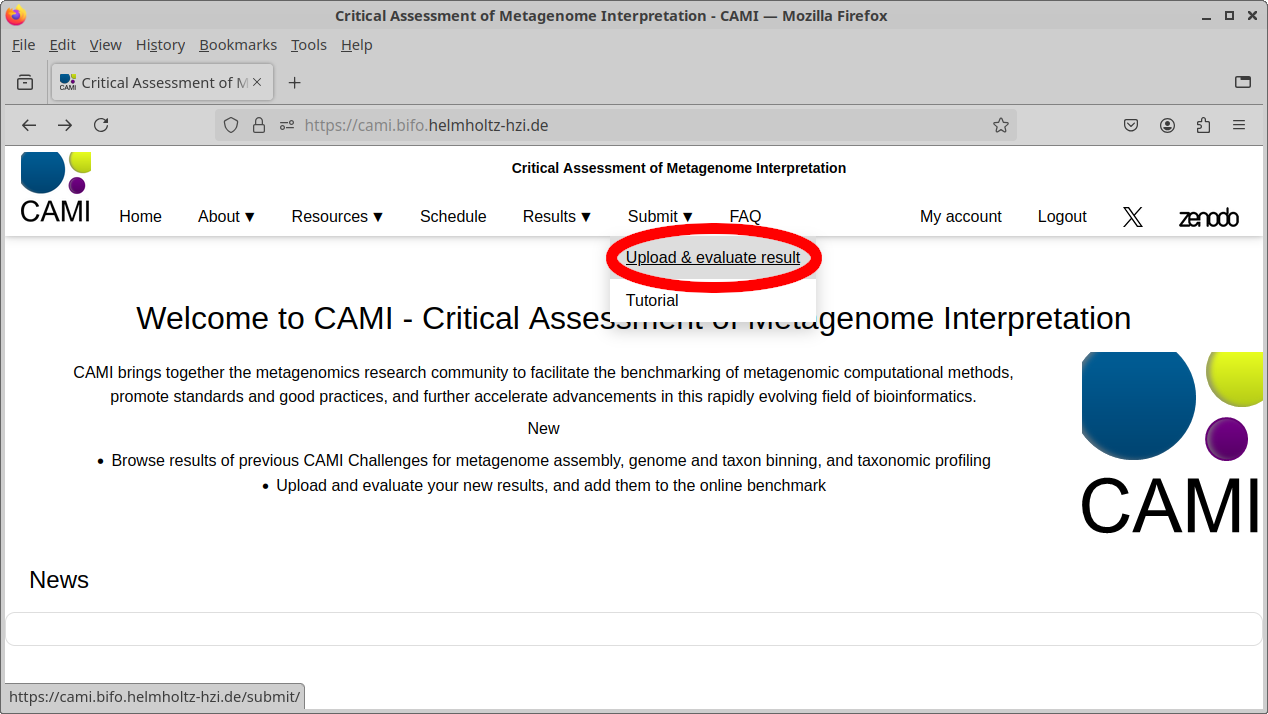
Submit your results through the Upload & evaluate result page (this link), as also shown in the image below, and follow the tutorial.
File format: Be aware of the file format for assembly, binning, and profiling. Binning and profiling files need to contain in the header the exact sample ID (field SampleID in the format) the result is of. Files not meeting the format requirements will be rejected by the system.
Reproducibility requirement: To support reproducibility and evaluate computational performance, all submitted results will be reproduced and reassessed using the submission metadata specifications provided by participants, including the exact software versions, parameters, and reference databases used by challenge participants, Further information might be required to ensure reproducibility, such as whether the software outputs the same result for every run on the data or whether it uses a “seed”, and whether the result is the combination of the output of multiple runs or selected from the “best” run. When feasible runtime and memory use will be measured under standardized hardware conditions.